25 years building and leading high-caliber design organizations across IoT, fleet telematics, enterprise software, and complex multi-stakeholder products. I came up as a designer and I still care deeply about the craft. But where that passion lives now is in the designers I hire, develop, and give room to grow.
25
Years leading design
3×
Founder / CXO
1
Issued IoT patent, Microsoft
∞
Industries served
Design philosophy
Org building over output
At scale, the craft question becomes secondary. The real question is whether your team can execute without you holding every decision. I hire for character and coach for craft.
Domain depth as a design tool
The best UX decisions come from understanding the physical world your users operate in. I've designed for drivers, fleet managers, warehouse operators, and IoT hardware engineers, people whose work has real consequences.
Business outcomes, not awards
Connect every decision to a number the business cares about. Design is how we move the needle. I frame every design decision in terms of customer success, retention, and operational efficiency, not just craft quality.
Hardware constraints as a creative input
Having shipped products at the intersection of physical hardware and software, from IoT sensor platforms to dashcam telematics, I design with real-world deployment constraints in mind from the start.
Built a fleet telematics and final mile delivery platform from the ground up, navigating a full consumer-to-enterprise pivot, hardware constraints in the field, and a co-integration partnership that expanded the platform into route optimization. Designed for the same user hierarchy Samsara serves daily: drivers, fleet managers, and enterprise stakeholders.
Origin
A dual-sided product: consumer protection + insurance intelligence
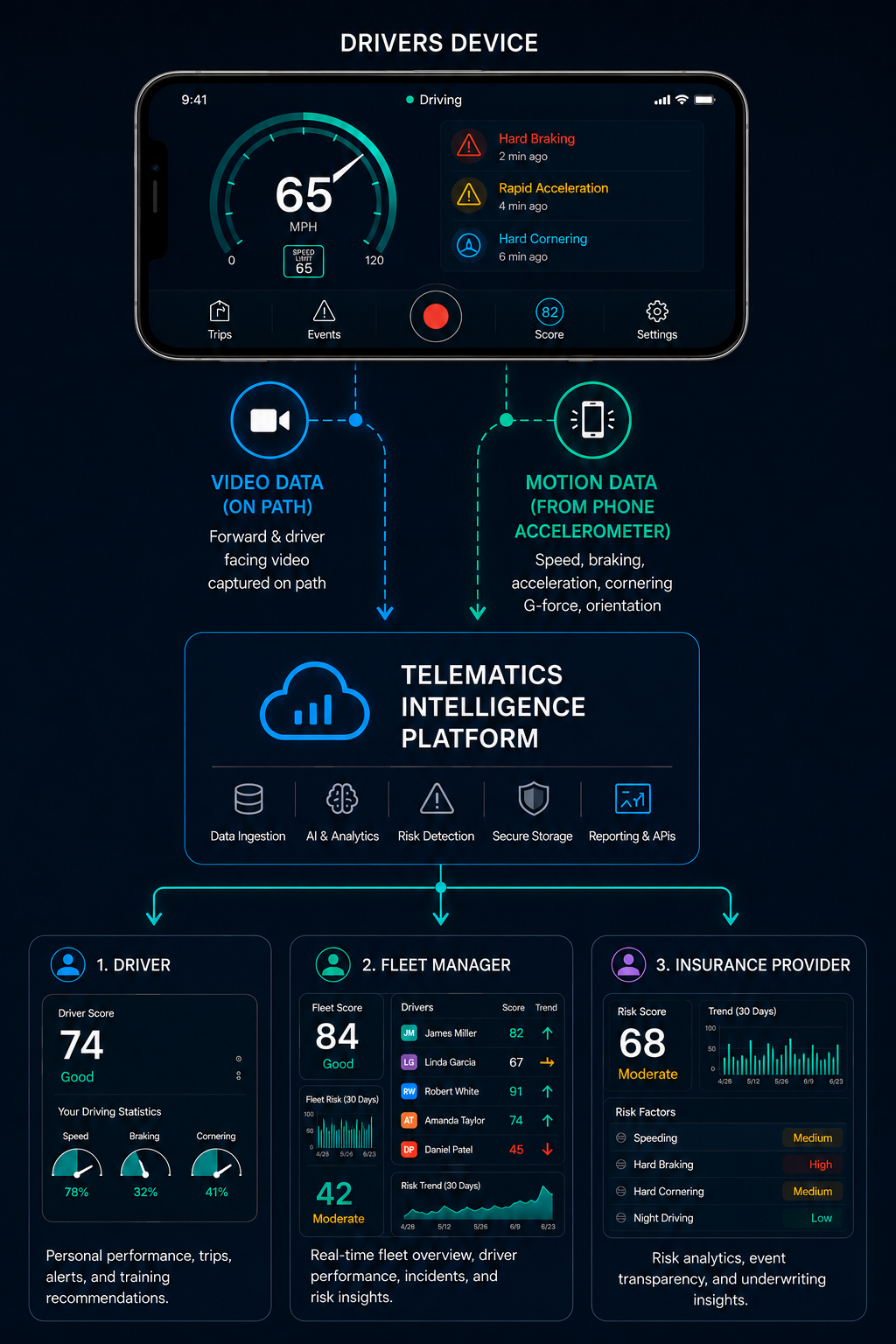
Greenlight launched as a phone-based dashcam platform requiring zero hardware installation, just a charging cradle every driver already had. The app ran continuous loop recording and triggered automatic event capture on hard braking or accident detection, creating an always-on protection layer for drivers without friction.
In parallel, a separate product surface streamed real driver telemetry to insurance partners, enabling them to identify and reward genuinely safe drivers through actual behavioral data rather than actuarial proxies. One device, two distinct products, one platform architecture.
Platform architecture — video + motion data from a single device, processed once, powering three distinct stakeholder product surfaces
The pivot
Discovery through partnership: the fleet opportunity
During insurance partnership development, a pattern emerged in the conversations: fleet managers needed exactly what the insurance product was doing, but applied internally to their own drivers. The market signal came from listening, not from internal roadmap pressure.
My background in hardware-driven software experiences at Microsoft provided the systems design framework to architect the pivot properly, not as a feature addition, but as a platform reorientation with distinct UX layers for each stakeholder.
Phase 1
Consumer + insurance
Phone-as-dashcam for individual drivers + telemetry stream to insurance partners. Single device, two products.
Discovery
Fleet signal surfaces
Insurance partner conversations reveal that fleet managers need the same behavioral data, applied internally. The fleet pivot came from a conversation, not a roadmap.
Phase 2
Fleet telematics platform
Driver rating system, real-time behavior observation, corrective action workflows, and model driver identification for fleet managers. Secured initial fleet clients.
Constraint
Hardware limits discovered in field
Phone overheating in hot climates on long drives. Video processing + charging combination exceeded thermal limits. Diagnosed in software first, then accepted as hardware constraint.
Dashcam feature disabled. Telemetry layer retained, the defensible IP. Proactively engaged clients to reframe value around behavioral data. Dashcam hardware had simultaneously commoditized, validating the decision.
Phase 3
Final mile co-integration
Partnership-driven expansion: co-integrated Greenlight's driver telemetry with a partner's routing infrastructure, extending the platform into final mile delivery optimization.
User model
Three distinct stakeholders, one platform
The design challenge in fleet telematics isn't the data. It's relevance. The same telemetry has to feel purpose-built for a driver focused on their score, a fleet manager focused on their risk exposure, and an insurer focused on their book. One platform, three native experiences.
Driver
Protection + feedback
Automatic event capture
Personal safety record
Behavior score + coaching
Zero-friction setup
Fleet manager
Visibility + risk reduction
Real-time driver behavior
Per-driver telemetry ratings
Corrective action workflows
Model driver identification
Pattern analysis over time
Enterprise / insurer
Data + intelligence
Real behavioral data (not proxies)
Safe driver identification
Risk portfolio insights
Partner product integration
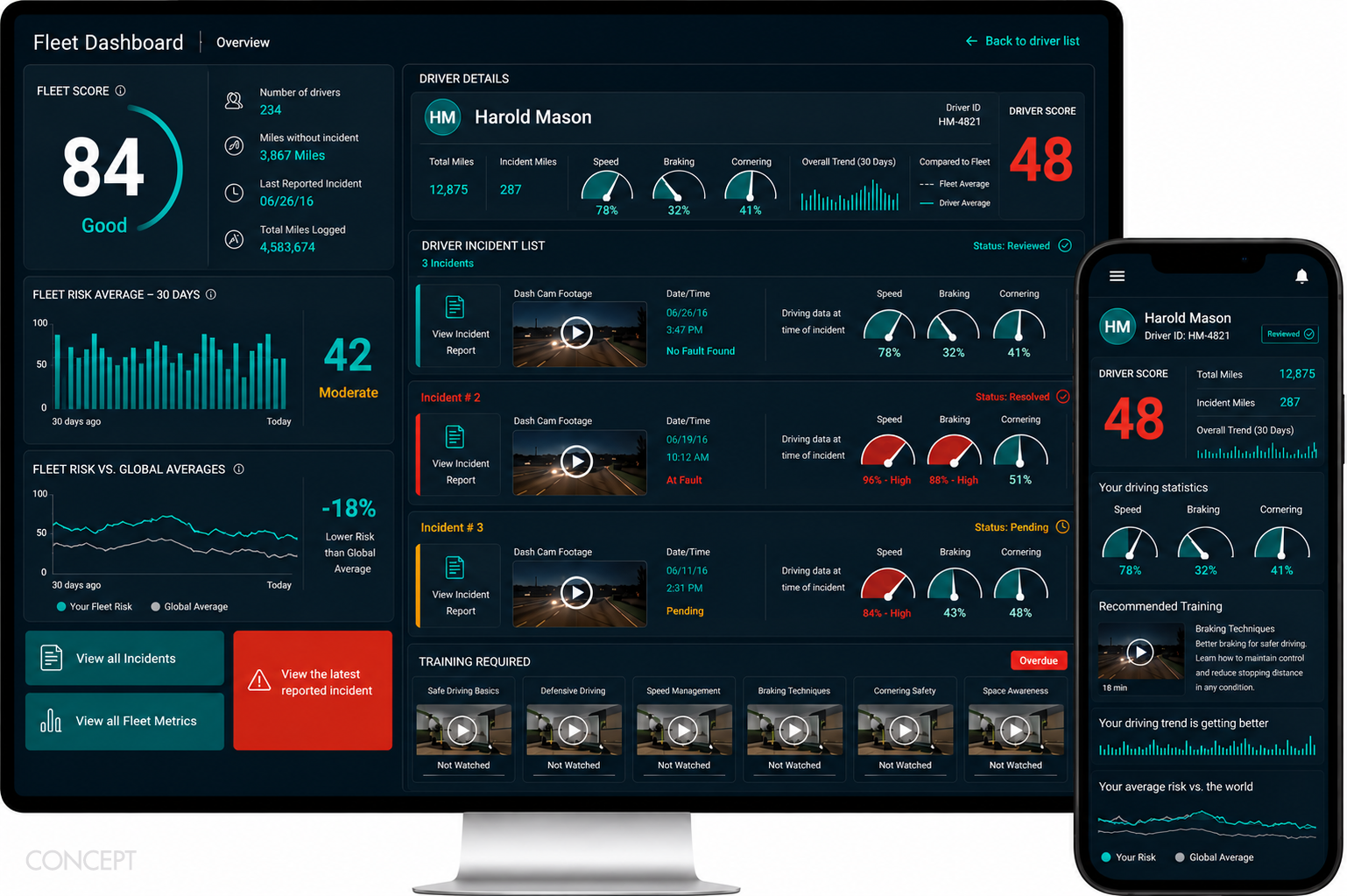
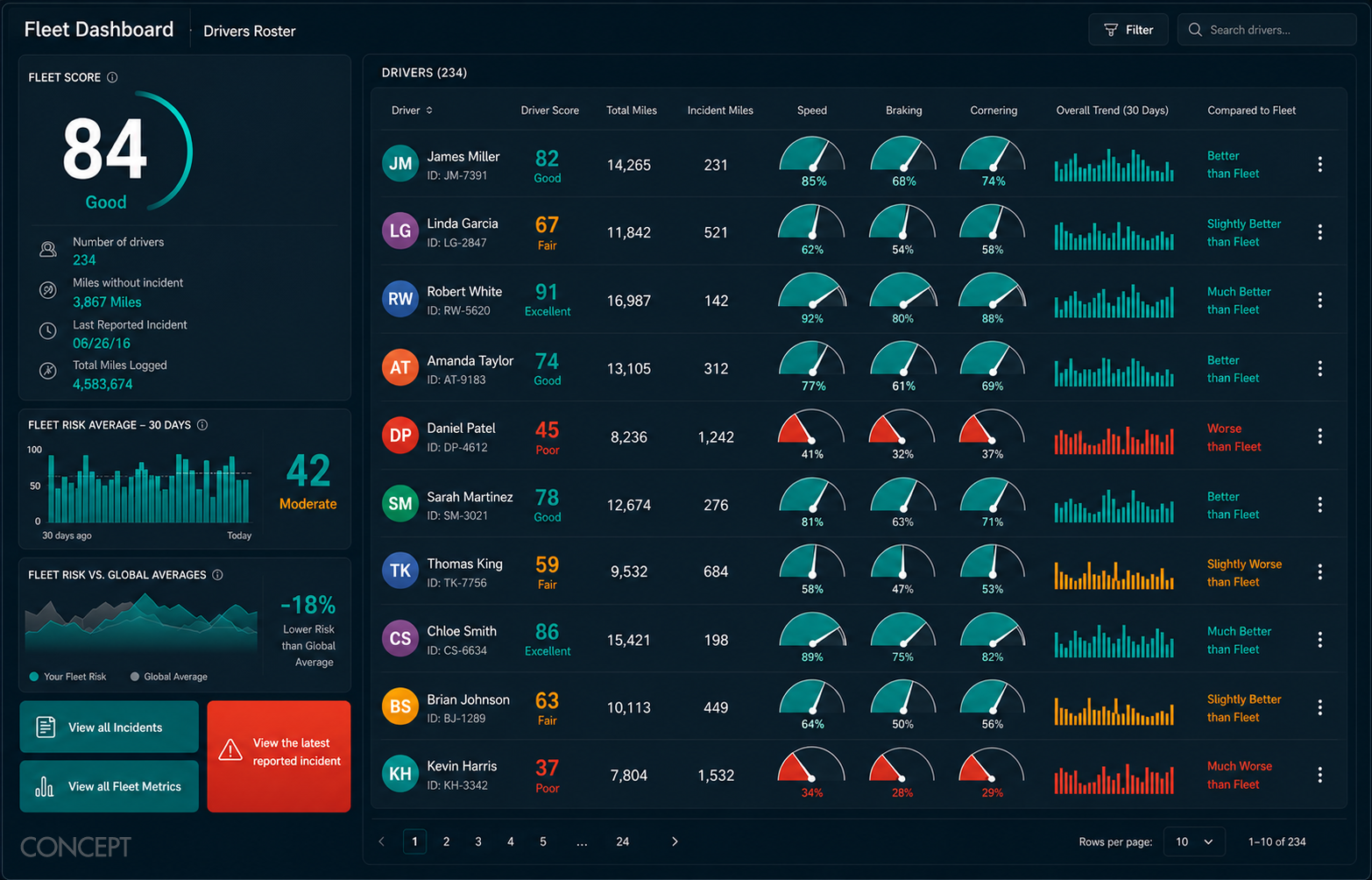
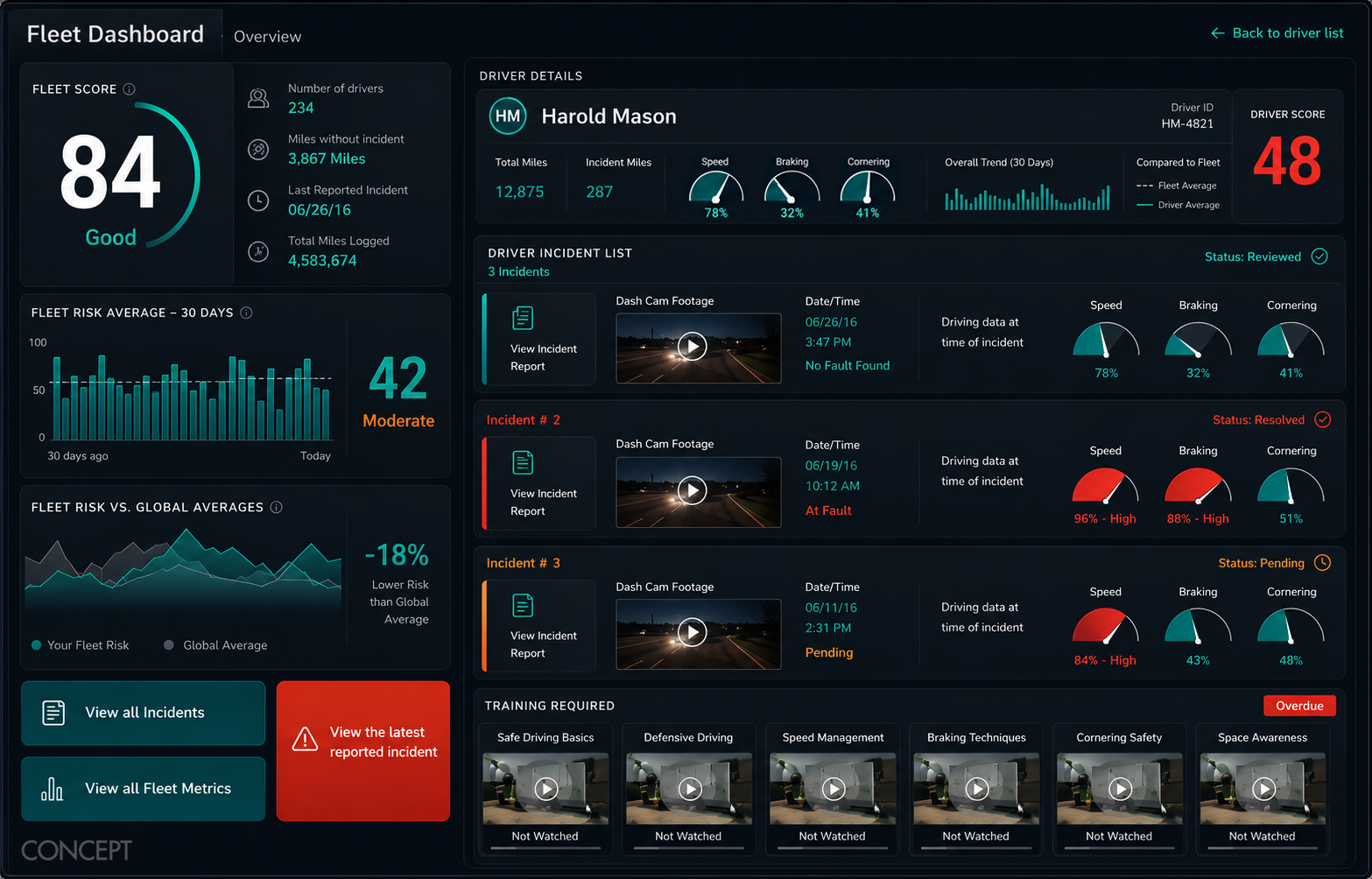
Two sides of one data platform — fleet manager's incident review and corrective action workflow (left) alongside the driver's personal score and coaching view (right)Fleet manager dashboard — driver roster with telemetry ratings and behavior indicators across 234 driversDriver detail — incident review with dash cam footage, telemetry at time of event, fault determination, and corrective training assignment
Outcomes
3
Distinct product surfaces shipped across stakeholder tiers
∅
Client churn after dashcam phase-out — value retained through telemetry layer
+1
Platform expansion into final mile via co-integration partnership
Add fleet counts, driver counts, or retention metrics here when available.
Neon Machine / Shrapnel · CXO (Head of Experience), 4.5 years
Keeping the rudder pointed through three CEOs, two industry crashes, and $40M in funding
As CXO of Neon Machine, I am a key member of the leadership team that built the studio to 150+ people, directly leading and scaling a ~40-person design organization across three funding rounds (~$40M). I navigated the simultaneous collapse of the blockchain and game industries, multiple scale-up/scale-down cycles, three CEO changes, and full founder turnover, while keeping design vision intact and the product moving toward launch. My team's work contributed directly to each funding round, a vibrant marketplace, and more than 8 million matches played during Early Access. Shrapnel is now one of five games selected as a launch partner for China's national blockchain gaming initiative.
Context
The hardest conditions a design leader can operate in
Neon Machine was building Shrapnel, a AAA blockchain-based extraction FPS, at the intersection of two industries that simultaneously entered historic downturns. Crypto winter collapsed the web3 market. A broader game industry contraction followed. The company went through three CEO changes, the departure or removal of all original founders, and multiple rounds of scaling up then down then up then down again.
Through all of it, the design organization had to maintain vision coherence, team morale, product momentum, and stakeholder confidence. That took more than design management. It took executive leadership through constant change.
Org building
Key studio leadership: 10 founders to 150+, design org at ~40 people
Joined at inception as a non-founder early team member and built the experience organization from the ground up, defining the team structure, hiring philosophy, discipline mix, and operating model that would need to scale rapidly and then survive significant contraction without losing its core.
At peak scale, Design Managers, Art Directors, and Development Managers all reported directly into the experience organization, spanning internal FTEs, contractors, and third-party development partners. The org covered the full experience surface: in-game UX, out-of-game product, marketplace, ecosystem, and all external brand and communications channels.
Founding
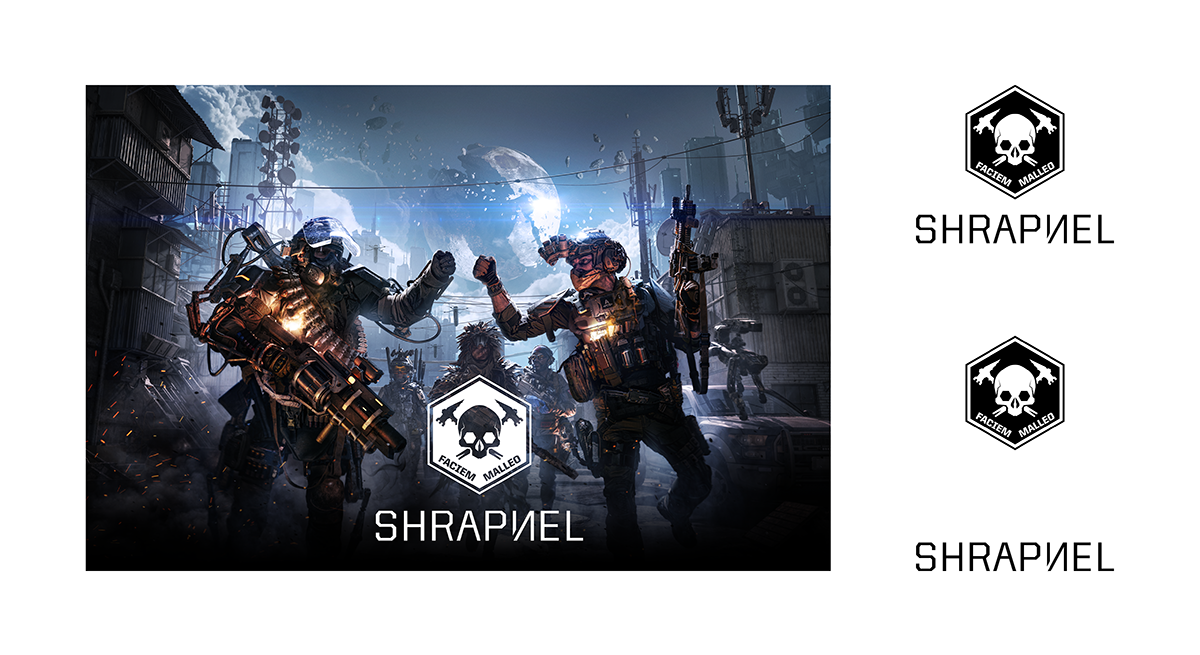
Initial branding + product announce
Defined the initial brand identity and designed the first public-facing user experiences, establishing the visual and product language for Shrapnel's market entry.
Scale-up
Studio: 10 founders → 150+ · Design org: ~40 people across 3 funding rounds
As a key member of the studio leadership team, helped build Neon Machine to 150+ total people while directly scaling the design organization to ~40, curating talent across game design, UX/UI, art direction, systems design, and development management. Maintained culture and design coherence through rapid growth.
Industry crash
Crypto winter + game industry contraction hit simultaneously
Managed scale-down while protecting the team's core capability and morale. Maintained design vision through three CEO transitions and full founder turnover, providing continuity when leadership above was in flux.
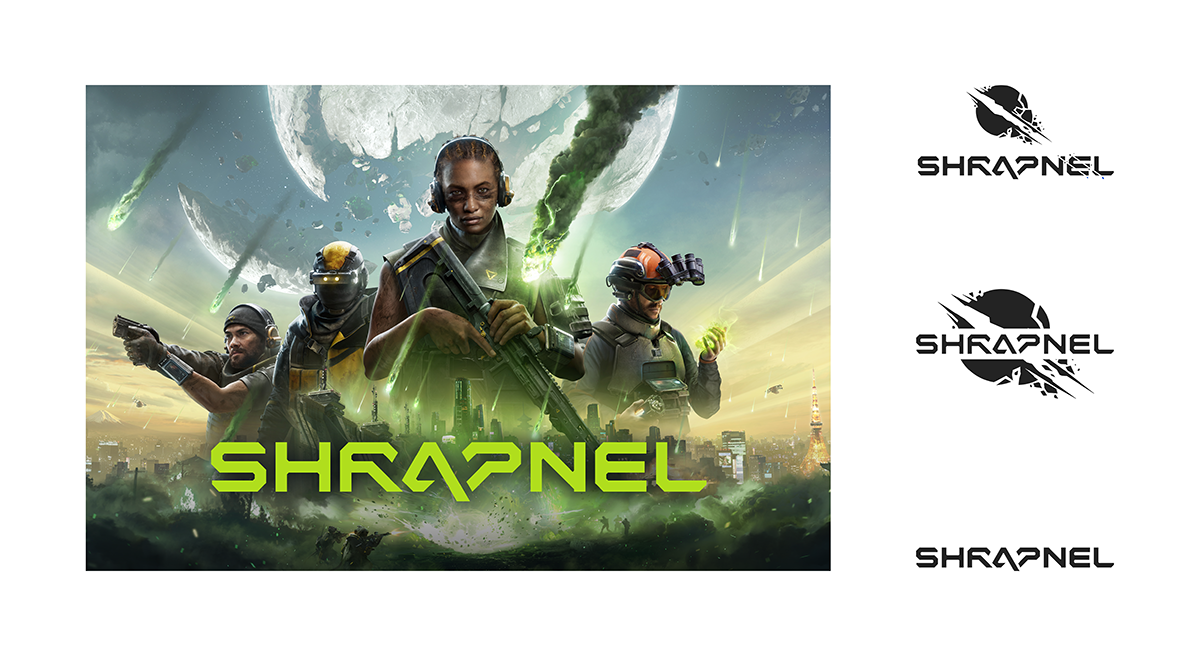
Re-brand
Second brand identity as product direction evolved
Led the rebranding effort as the team developed deeper understanding of where Shrapnel was going, aligning visual identity and product language to a more mature product position.
Pivot + recovery
Strategic plan that redirected the company toward China launch
Presented the plan that navigated Shrapnel through the broader industry collapse and toward its current position: one of five games selected as a launch partner for China's national blockchain gaming initiative.
Brand work
Two brand identities across the product arc
Led two full rebrands. The first got Shrapnel into the market. The second reflected what we learned once we got there.
Brand v1 — initial identity system, market launch 2022Brand v2 — evolved identity aligned to mature product direction
Products owned
Product ownership across the full ecosystem
As head of experience, product ownership wasn't limited to design direction. I defined vision, built the teams, and guided concept through delivery across every major product surface.
Product Ownership
Full ecosystem, vision to delivery
User Generated Content
In-game gameplay experiences
Economy oversight
Marketplace
Account + customization
Player Focus
Designing for expression, not just function
Player needs as the design starting point
Gameplay experiences that enable unique playstyle
Products that serve hardcore and new players alike
Head of Experience
100K-foot view across the brand
Preparing studio and products for launch
All surfaces working together, not in isolation
Vision definition through team empowerment and execution
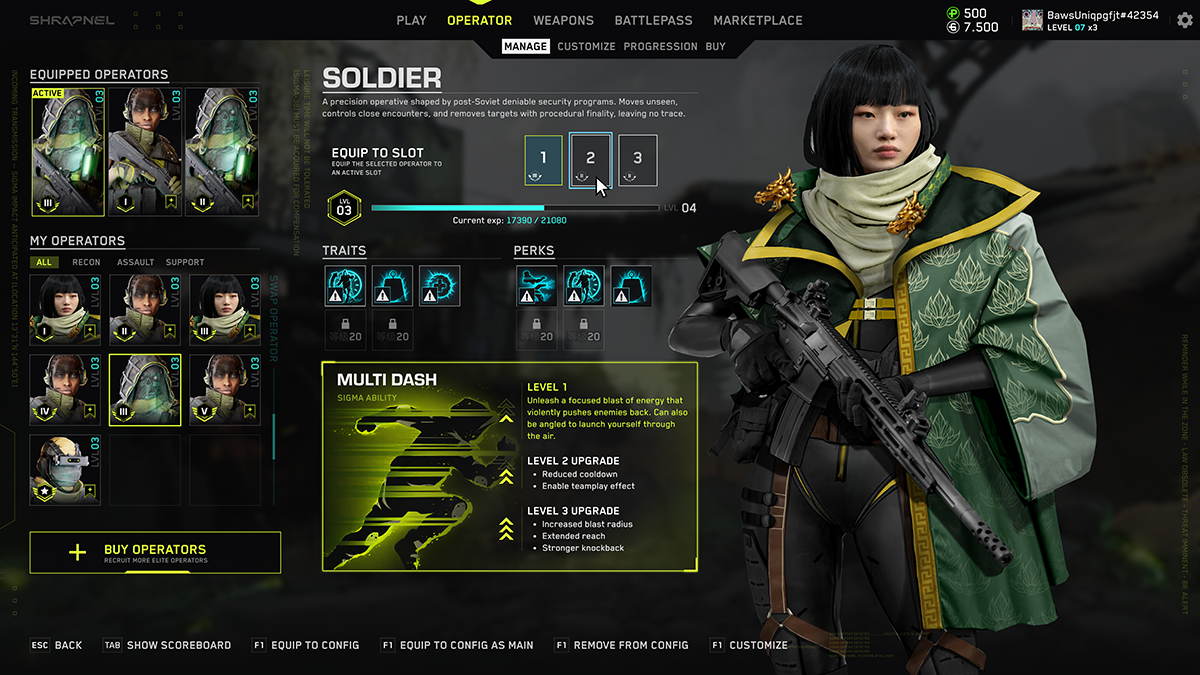
Shrapnel operator management — player expression, customization, economy, and progression surfaces across a single product experience
What this demonstrates
Design leadership in conditions that test organizational resilience
Shrapnel isn't a game design story. It's a story about keeping a team pointed in the right direction when everything around you is in flux. Maintaining a coherent product vision through three CEOs requires that the vision live in the design organization, not in any individual leader above it. Surviving two simultaneous industry crashes requires that the team's identity be rooted in craft and mission, not market momentum. Keeping talent through scale-down cycles requires that people believe in both the work and the leadership.
Shrapnel is one of five blockchain games selected for China's national launch. That result belongs to the team that kept executing through three leadership changes. The design org is that team.
Microsoft · Campus of Tomorrow — IoT Systems Design
Designing the intelligent building platform for Microsoft's Campus of Tomorrow
Built and led the team that took a campus-scale IoT occupancy platform from concept to patent, designing the sensor hardware, physical enclosure, deployment strategy, and multi-stakeholder software experiences from the ground up. The platform generated millions in building operational savings within 12 months and contributed directly to Microsoft Azure IoT revenue and patents.
The problem
Real estate at Microsoft scale runs blind without real-time occupancy data
Microsoft's campus buildings were being operated on schedule and assumption. HVAC, electrical systems, and infrastructure ran at capacity regardless of actual occupancy. The opportunity was clear: replace schedule-based building operations with real-world occupancy data to drive intelligent run-up and run-down of building systems, reducing operational costs across an entire campus portfolio.
The challenge was that no affordable, deployable sensor platform existed that could be designed, manufactured, and rolled out at Microsoft campus scale. We had to build it.
Users
Four distinct stakeholders, two product surfaces
Four stakeholders, one data platform. The design challenge was building surfaces that felt native to each without fracturing the underlying system.
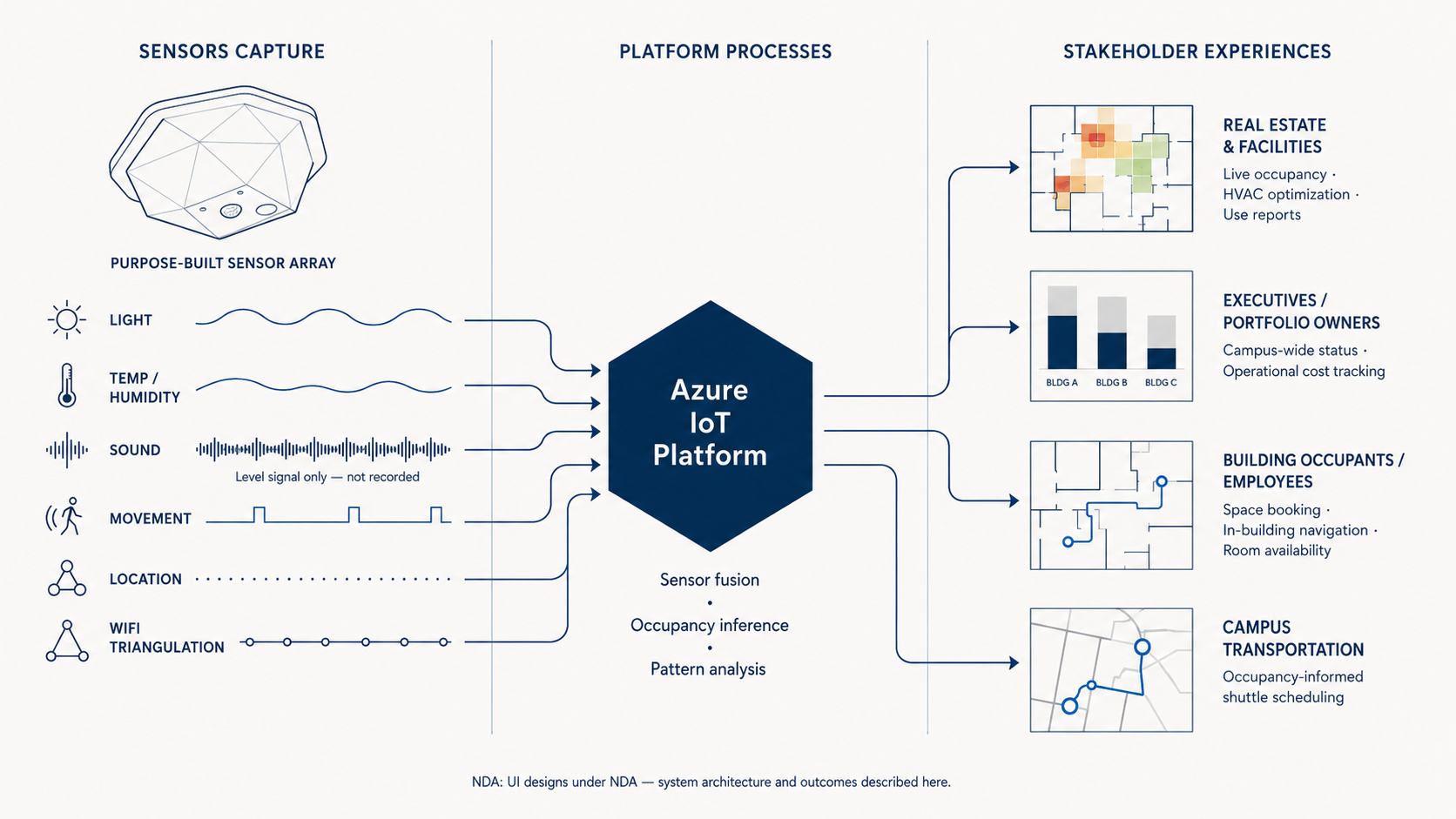
Six real-time signal types, each requiring its own design thinking
The sensor array wasn't a commodity component selection. Each signal type introduced distinct design challenges around data interpretation, user-facing representation, privacy, and the gap between raw measurement and actionable insight.
Light
Internal + external ambient state
Monitored both internal lighting conditions and external light through windows, informing automated lighting optimization and establishing environmental context for other sensor readings. Enabled facilities systems to respond to natural light availability rather than running on schedule.
Temp / humidity
Local and campus-wide environmental state
Provided granular environmental data at the room level, aggregating up to floor, building, and campus views. The primary driver for HVAC optimization, enabling run-up and run-down decisions based on real environmental conditions rather than time-of-day assumptions.
Sound
Two modes, two use cases, and a trust design problem
During business hours, ambient decibel levels informed workspace activity state, distinguishing active collaboration zones from quiet focus areas, and surfacing noise distribution patterns across open floor plans. Sound data was processed as level signal only, never recorded. The system read decibels in a space. Not voices.
Evening passive monitoring served a fundamentally different purpose: predictive facilities maintenance. A mechanical system degrading over time, an HVAC bearing going out for example, changes the harmonic signature of a space gradually. By establishing acoustic baselines overnight, the platform could detect anomalous volume drift before a failure occurred, and flag after-hours sound anomalies as actionable signals for facilities teams.
Employee trust was treated as a P0 design problem, not a communications task. The team ran proactive engagement: lunch-and-learn sessions, direct conversations with skeptical employees, and radical transparency including selective code exposure to concerned parties. We showed people exactly what the system captured and what it ignored. The framing shifted from surveillance to partnership, demonstrating that the noise data could surface things like a single open-plan section accounting for 75% of workspace sound, providing management with a coaching signal rather than a monitoring tool. Fear-based employees became evangelists through inclusion in the conversation, not reassurance from above.
Movement
The stillness problem, and how multi-sensor fusion solved it
Motion detection alone fails in knowledge worker environments. A developer in deep focus at their desk generates no motion signal, triggering false vacancy readings that would cause the building to prematurely shut down HVAC and lighting around occupied spaces. This was the core systems design challenge of the platform.
The solution was multi-sensor fusion with decay tuning: motion alone was not sufficient for occupancy confirmation. Presence was determined by correlating motion with ambient temperature, humidity, and sound, understanding that a person in a space changes all three baselines measurably even when sitting still. Each space type (open desk, focus room, meeting room) had its own learned ambient baseline, established through pattern monitoring, against which real-time readings were evaluated.
Beyond binary occupancy, the platform developed methods, protected under NDA, for distinguishing single occupancy from multiple occupants through multi-sensor signal correlation. This enabled per-person capacity awareness rather than simple occupied/vacant states, directly informing both space booking UX and facilities optimization decisions.
Location
Network presence + waypoint navigation
Device presence on the campus network provided a coarse occupancy signal, confirming that people were in a general area even when motion sensors showed no activity. Also served as the data layer for waypoint-based campus navigation, routing employees between buildings via shuttle and walking paths.
Triangulation
WiFi-based inner-building navigation
WiFi signal triangulation provided the precision location layer needed for in-building wayfinding, enabling turn-by-turn navigation to specific rooms, desks, and meeting spaces inside campus buildings where GPS is unavailable. This data also powered the real-time occupancy heatmaps surfaced to facilities operators.
What we built
End-to-end: from sensor hardware to software experience
We didn't pick up a sensor SDK and design around it. We designed the sensor, the enclosure, the deployment process, and every screen above it. My team owned every layer from the physical object in the ceiling to the executive dashboard on the screen.
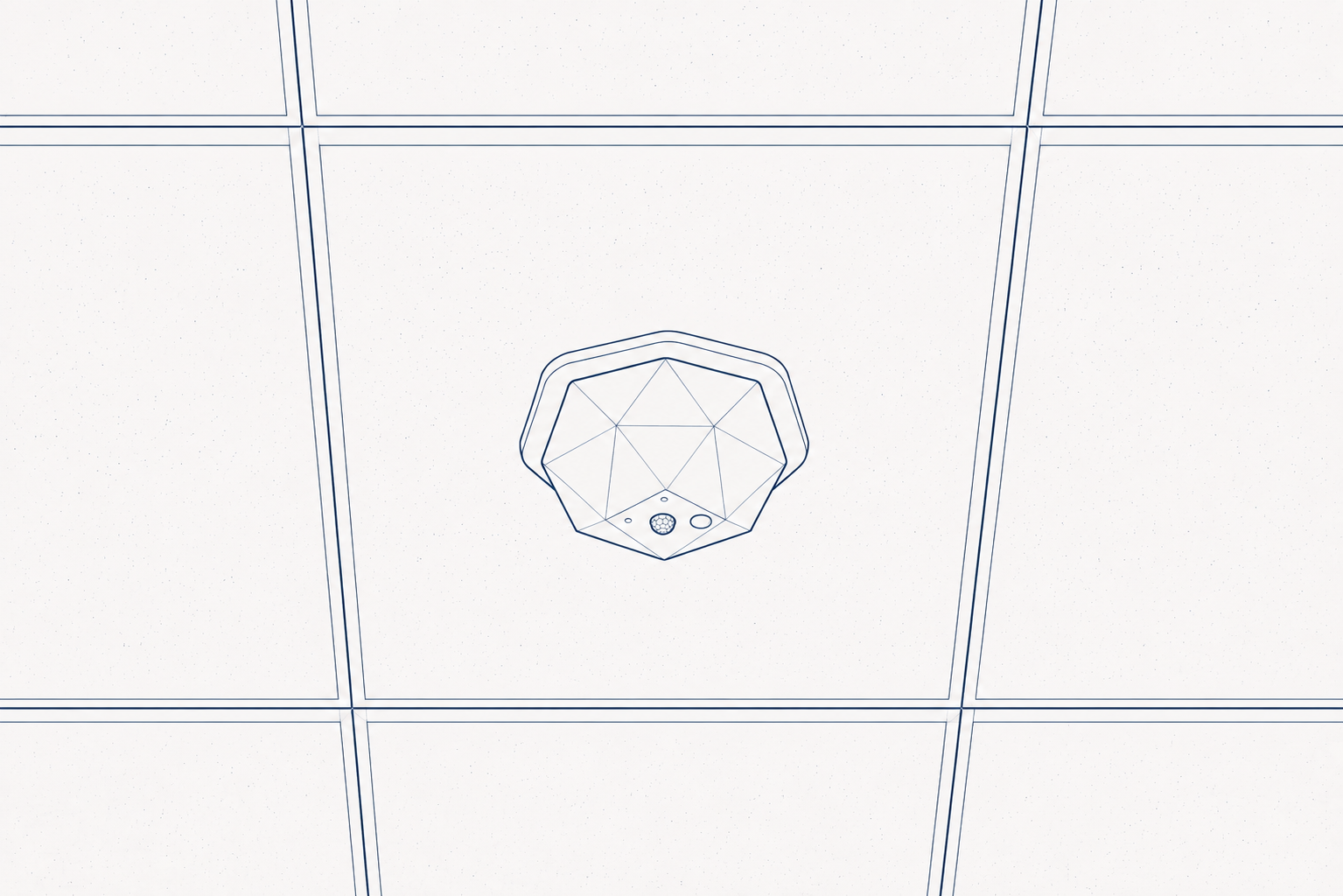
Sensor array and enclosure — purpose-built hardware designed for cost-effective deployment across varied building environments at campus scale
Hardware
Affordable sensor array + enclosure design
Designed and prototyped a sensor array purpose-built for occupancy detection at campus scale, balancing accuracy, cost-per-unit, and the physical constraints of varied building environments. Iterated from prototype through production hardware revision, including the sensor package, processing unit, and physical enclosure.
Deployment
Deployment strategy + installation oversight
Designed the physical deployment strategy for scaling across campus buildings, placement logic, installation process, and the operational playbook for rolling out the system. Oversaw initial test rollout before full Campus of Tomorrow deployment.
Facilities UX
Web UI + PWA for Real Estate and Facilities teams
Campus map with live building status, building-level dashboard, real-time occupancy data, historical heatmaps, and use reports, giving facilities operators the data to make informed run-up/run-down decisions for HVAC, electrical, and building infrastructure.
Employee UX
In-building displays + employee PWA
Reused the same sensor hardware to power an employee-facing experience: workspace and meeting room availability, smart space booking, in-building wayfinding via WiFi triangulation, and integration with campus shuttle and transport services.
Platform
Azure IoT data platform
The sensor and software system ran on and helped solidify the Azure IoT Platform. Our design work contributed directly to Azure IoT's product definition and revenue, and resulted in patents for Microsoft.
System architecture — six sensor inputs, multi-stakeholder product surfaces, and Azure IoT platform integration
NDA — UI designs not shown
The user interface designs are under a non-disclosure agreement. The problem space, user research, design decisions, system architecture, and outcomes described here are available for conversation. I'm happy to walk through the design thinking in detail in a private discussion.
Customer proximity
The customer isn't always who you think
After our first sensor deployment, I tracked installation time and went back to the person who mattered most for that problem, not a business stakeholder, but the installer. The guy who'd spent eight hours bent in a drop ceiling told me he was so sore at the end of each day that he couldn't play with his daughter when he got home.
I took that back to the work. We redesigned the installation process and the hardware mounting around his physical reality. After our next large deployment, over 100 sensor arrays in a single evening, he came in the following morning and hugged me. "Thank you for making this so easy. I was able to play with my daughter last night for the first time in a long time."
Per-unit installation time dropped from approximately 15 minutes to 3 minutes. The number is useful. The thing that stuck was simpler: the person whose life your product touches most directly is always a customer, whether or not they show up on a stakeholder map.
Team + culture
Investing in early-career talent
The team I built included Microsoft Accelerated College Hires (MACH) — recent graduates just entering their careers. Over two years together, I invested as heavily in their development as in the product itself: building skills, building confidence, and building the team culture that made the work better. At the end of the engagement, my MACH team members nominated me across all MACH-supporting teams at Microsoft for the Top Mentor award. I won.
Outcomes
$M+
Building operational savings within 12 months of deployment
M+
Data points collected across campus sensor network
$M+
Azure IoT revenue contribution — platform design established services and patterns adopted by subsequent Microsoft IoT clients
1
Issued patent: US 10,419,540 — IoT Systems Design
Specific figures available in conversation under NDA.
Contour · Director of Design · 2013
Hardware designSensor-driven UXData as productGPS + 6-axis telemetryCommunity platform
Where it started: creating products from sensor data
Before Microsoft's Campus of Tomorrow and before Greenlight's fleet platform, there was Contour. Contour was an established action camera company with products in market and a clear competitive target: GoPro. I was brought in to build the team and deliver the next generation, a sensor-laden camera and integrated ecosystem designed to give Contour a fundamentally different product position. We built the team, designed the full system, and completed the prototype. The funding round needed to take it to production fell through, and the company made the strategic decision to close. The design work is under NDA. But the thinking it produced, that sensor metadata is a product foundation, not a byproduct, has shaped every hardware-driven software experience I've built since.
The product
A camera that knew what it was filming
Contour had cameras in market and a recognized brand in the action sports space. My mandate was to build the team and deliver the next generation: a direct GoPro competitor with GPS and 6-axis motion data captured continuously alongside the video recording, turning the camera into a sensor platform rather than just a capture device. The hardware team I built and led included talent recruited specifically from Dyson's design organization, bringing industrial design rigor from one of the most hardware-obsessed companies in the world.
The camera, app, and editing software were designed as an integrated ecosystem, not a camera that happened to have an app, but a platform where the sensor data captured during recording became the raw material for entirely new product experiences.
NDA — designs not shown
Software design and visual work from this project is under NDA and cannot be shown. The product concept, sensor architecture, and design thinking described here are available for conversation in detail.
The insight
Sensor metadata as a product foundation
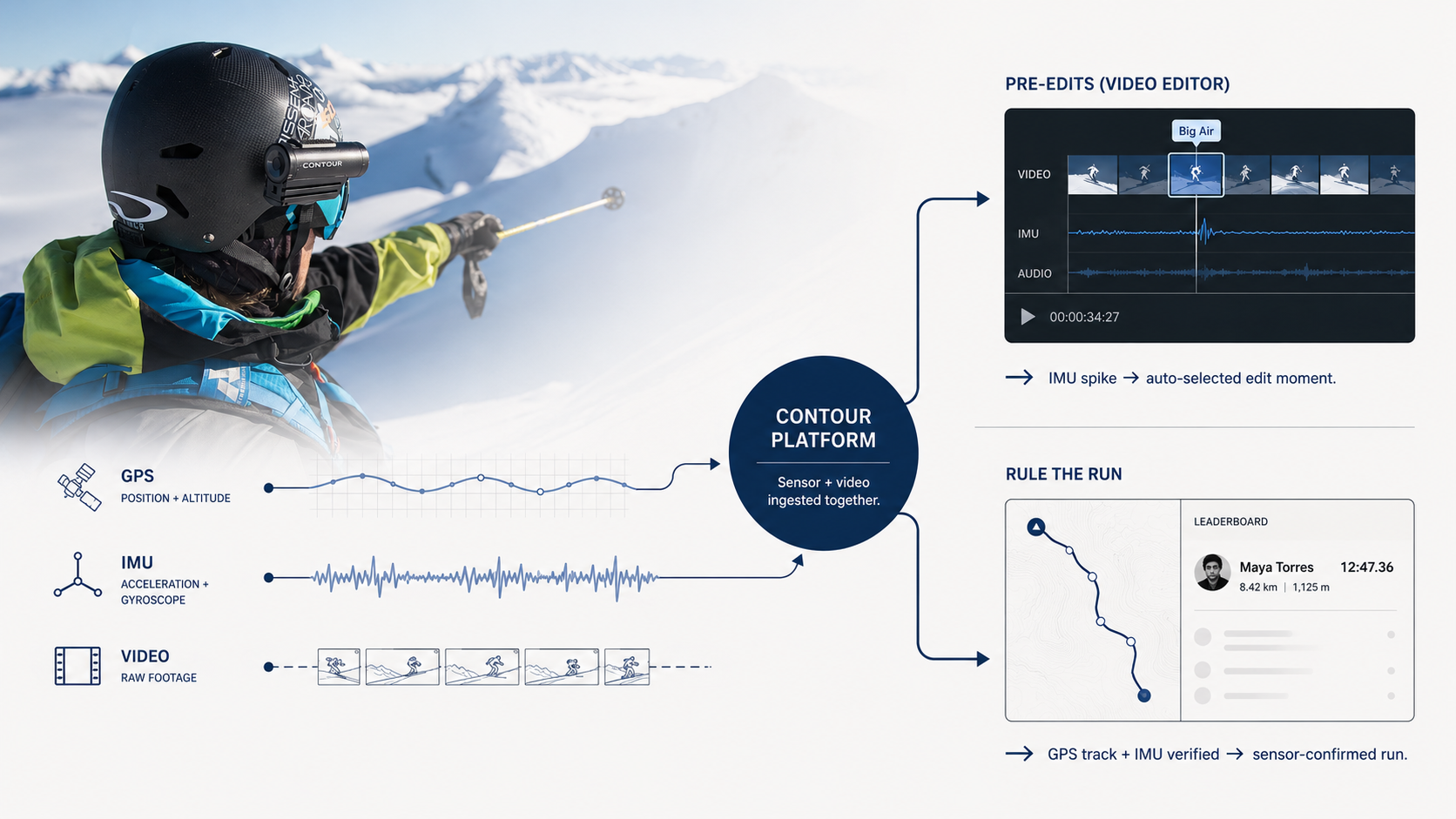
The GPS and 6-axis data logged during every recording session contained a complete behavioral record of what happened during that footage: speed, altitude, g-forces, heading, and rate of change across all axes. The question I kept asking was: what can we build from this data that the video alone can't give you?
Platform architecture — GPS + IMU + video captured together, processed once, powering two distinct product experiences
Pre-edits
Automatic action detection from sensor signals
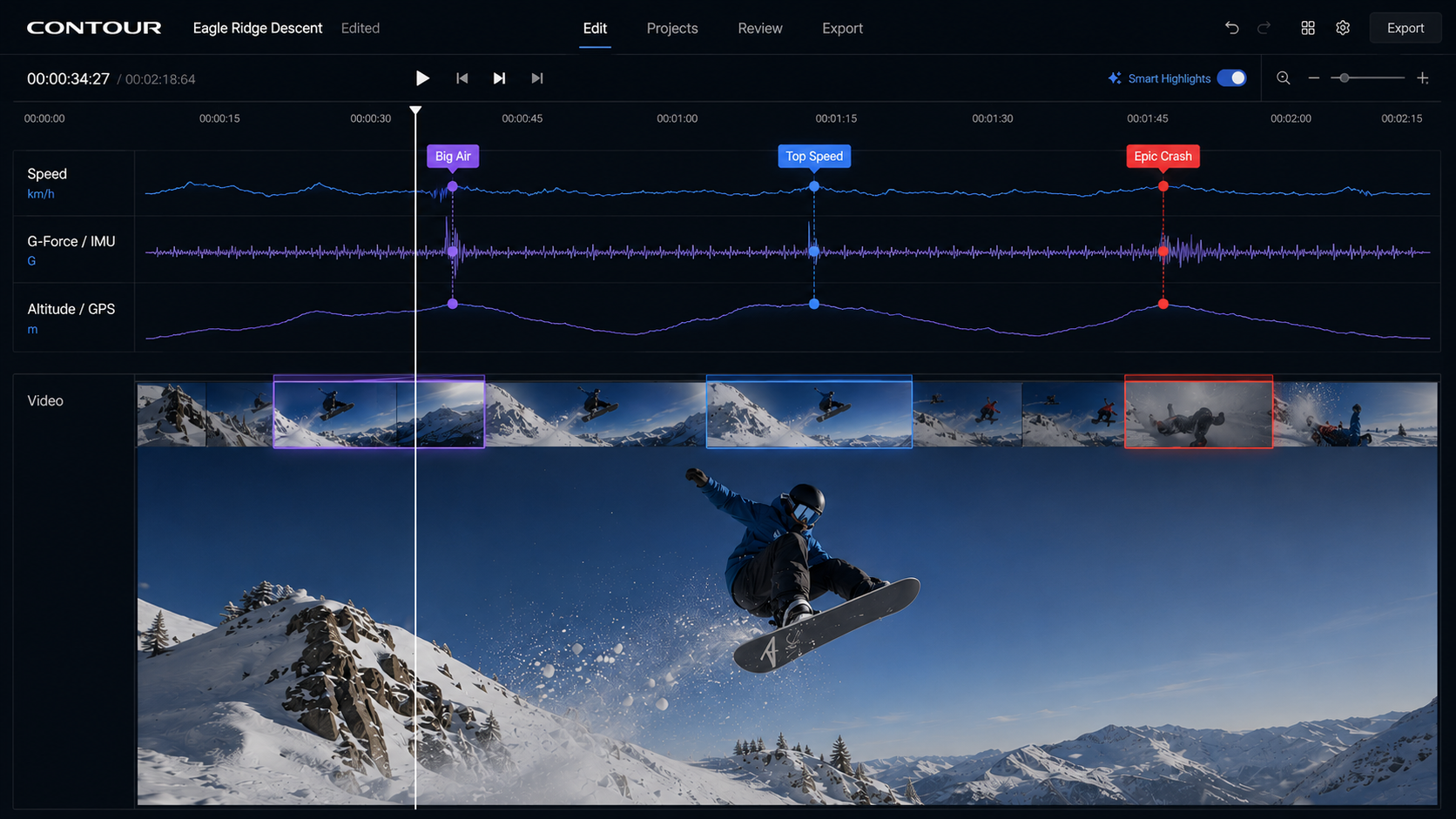
The metadata revealed moments of peak action within any recording: a big jump registered as a spike in vertical acceleration, a fast lap as compressed distance over time, a high-speed section as a velocity peak. We used these signals to propose edit cuts automatically, surfacing the best moments without the user having to scrub through footage. The sensor stack became an editing tool.
Rule the Run
A community platform built entirely on telemetry data
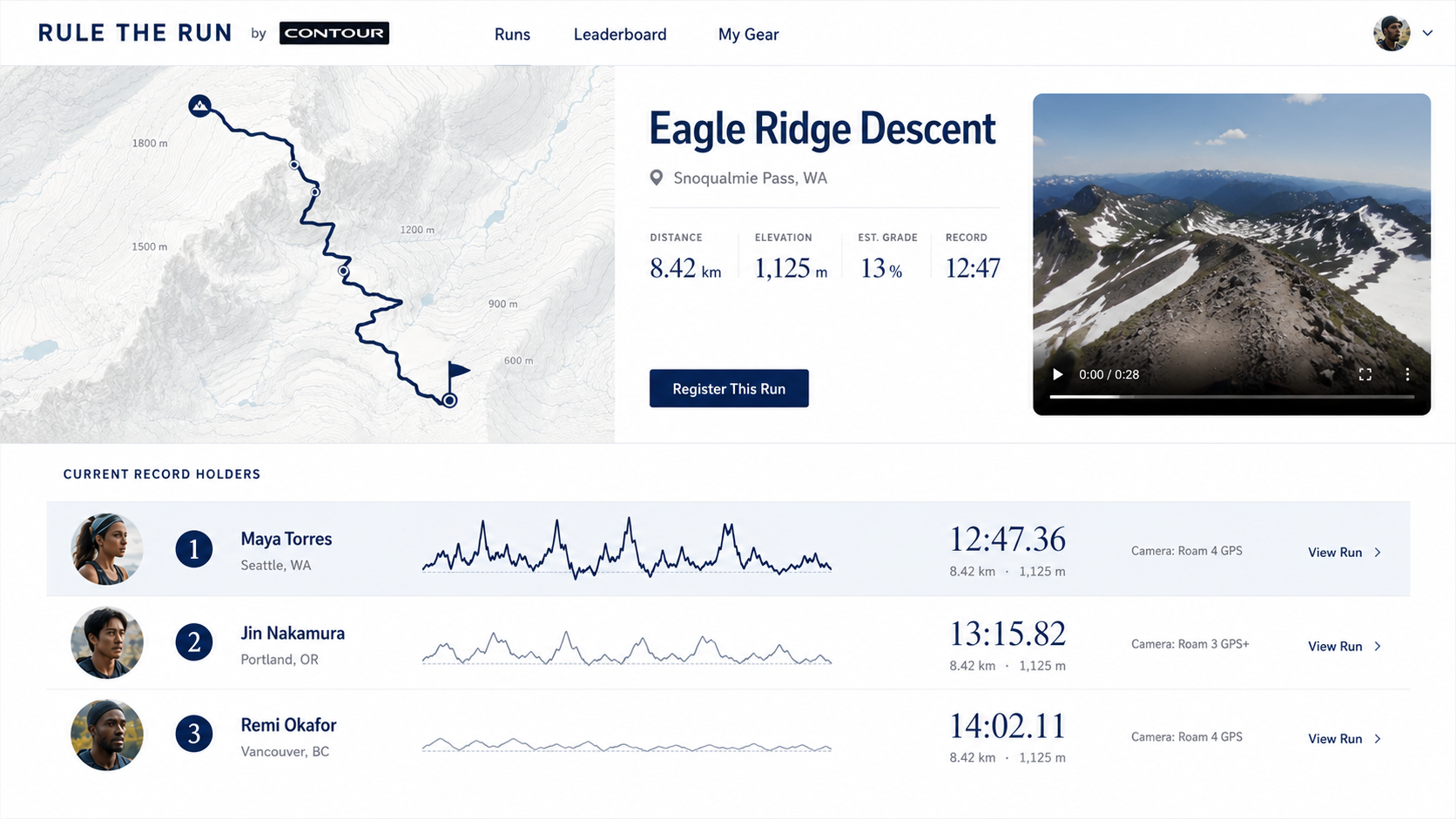
The larger concept was a platform called Rule the Run, users could register any physical "run" (a ski line, a race circuit, a trail, a jump spot), upload their video and associated sensor data, and become the benchmark to beat. Other users could attempt the same run, upload their data, and compete for the top position: fastest lap, biggest air, most ground covered. Bragging rights were data-verified, not self-reported. Discovery was sensor-driven: find runs near you, find runs that match your activity type, find the current record holder and see exactly what they did. This was Strava for action sports, built from a sensor stack we designed into the camera, before that category existed.
Pre-edits — video editing software concept: GPS and IMU spikes from the camera auto-select and tag peak moments in footageRule the Run — community platform built on camera telemetry: register a run, set the record, compete with sensor-verified data
The thread
The origin of a career-long design philosophy
The new product line was designed, prototyped, and ready for production. The funding round to take it there fell through, and Contour made the strategic decision to close. But the thinking it produced never left. The conviction that sensors generate data, data reveals what people actually do, and that's where the real product opportunities live. That conviction runs directly through the Microsoft Campus of Tomorrow platform, through Greenlight's driver telemetry system, and into every physical operations product I've touched since.
The category has changed. The philosophy hasn't: build products from what the data knows.
Let's talk.
I'm particularly interested in roles at the intersection of physical operations, IoT, and design org leadership, where design has real-world consequences and the team you build matters as much as the product you ship.